11 Nov
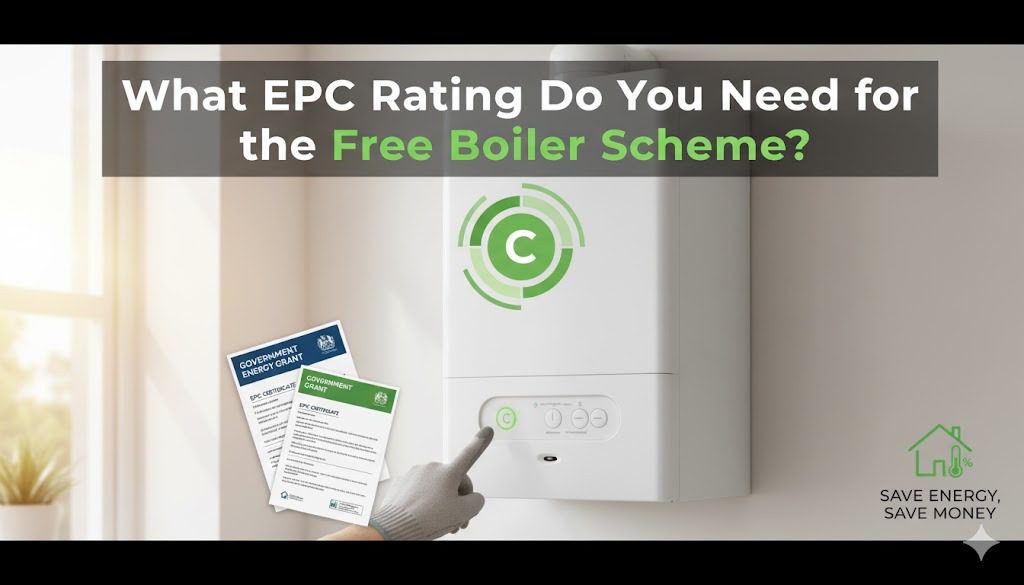
When you are applying for Free Boilers through ECO4, the most crucial element is your home’s EPC rating. Most people are confused about this element. Some believe any poor rating is acceptable, while others believe they can qualify without needing an EPC.
In this blog, we are going to spell it all out for you – what an EPC rating is, why it is relevant for boiler grants, and precisely what rating you must have to be qualified for a free boiler in 2025.
What is an EPC Rating?
EPC is short for Energy Performance Certificate. It’s a document that indicates how energy-efficient your house is.
- The rating runs from A to G, where A is the most efficient and G is the least efficient.
- The certificate also indicates factors such as heating costs, insulation levels, and carbon emissions.
- EPC ratings are now mandatory when selling, renting, or applying for energy schemes like ECO4.
In brief: an EPC is a report card for your home’s energy consumption.
Why Is EPC Important for the Free Boiler Scheme?
The Free Boiler Scheme under ECO4 aims to make UK homes warmer, less expensive to use, and more environmentally friendly. To achieve this, the scheme focuses on homes that waste the most energy.
Outdated, ineffective boilers are among the greatest offenders of low EPC scores. Through replacing these with new A-rated boilers, the scheme can improve a property’s energy efficiency.
This is why EPC ratings are utilised to verify who might qualify. If your house already holds a high score, chances are that you don’t require a new boiler. However, if it is low, a replacement would be extremely beneficial.
What EPC Rating Do I Qualify With for the Free Boiler Scheme?
To be eligible for a Free Boiler Scheme in 2025, your home must typically have an EPC rating of D, E, F, or G.
Here’s the lowdown:
- EPC Lower D: You might still be okay if your boiler is extremely old or not working, as replacing it might bring you nearer to a C rating.
- EPC E, F, G: These are deemed low efficiency and will be more likely to be funded through ECO4.
If your property is already rated A, B, or C, you will not normally qualify for a free boiler, as your energy efficiency is already deemed to be good.
How to Find Out Your EPC Rating
If you do not know your EPC rating, you can easily discover it.
- Visit the official government EPC register website.
- Search by postcode.
- Choose your home from the list.
If your house does not have an EPC, you will require an assessor to conduct one before applying for the Free Boiler Scheme.
Why Replace Your Old Boiler?
Now that you have learned about the EPC requirement, you may ask yourself: why should you replace an old boiler so much?
Here’s why:
- Old boilers cost a lot to operate. A lot of them waste 30–40% of energy.
- They fail more frequently. It can cost you hundreds of pounds to repair them.
- They decrease your EPC rating. An inefficient boiler brings your score down.
- They make your carbon footprint bigger. Using more fuel equals more CO₂.
By replacing your old boiler with an A-rated condensing boiler, you might save £350–£520 annually on heating costs.
How the Free Boiler Scheme Works
The Free Boiler Scheme is within the government’s ECO4 scheme. It helps low-income households, those on specific benefits, and those in poorly rated properties.
Step-by-step overview:
- Check Eligibility: You must be on qualifying benefits and reside in a property with EPC D–G.
- Home Survey: A qualified installer inspects your house and boiler.
- Approval Process: If you qualify by the rules, the grant is approved.
- Installation: A new boiler is fitted at no cost or very minimal cost to you.
EPC Rating and Other Home Improvements
Occasionally, the scheme does not end with new boilers. If your house is very poorly rated (such as F or G), you could also be provided with additional measures, including:
- Loft insulation
- Wall insulation
- Heating controls
- Renewable alternatives (such as heat pumps in off-grid homes)
This is because upgrading the boiler alone may not improve your EPC rating sufficiently.
What If My EPC Rating is Too High?
If your property is rated C, B, or A, you won’t typically be eligible for a free boiler installation grant.
But here’s the silver lining:
- You can still take advantage of other energy-saving initiatives.
- If your boiler is outdated, upgrading it yourself may still save money in the long run.
- Grants can be offered for other upgrades, such as insulation or renewable heating.
Common Misconceptions Regarding EPC and Boiler Grants
Let’s dispel some myths:
Myth 1: “Everyone receives a free boiler.”
No, only those living in homes with an EPC D–G rating and who satisfy benefit requirements do.
Myth 2: “A good EPC makes you eligible.”
Incorrect – low scores are the priority.
Myth 3: “EPC is paperwork only.”
EPC scores have a direct influence on whether you are accepted or refused.
Let’s Understand by Case Scenarios
- Case 1: A detached property with an F EPC rating and a faulty oil boiler. → Should be eligible for a free replacement.
- Case 2: A small flat with a C EPC rating and a 2010 gas boiler. → Not likely to qualify, as the rating is already efficient.
- Case 3: Semi-detached home with EPC E, antiquated non-condensing boiler, and the household is receiving benefits. → Highly likely to qualify under ECO4.
How to Enhance Your EPC Rating After Getting a Free Boiler
After you have your boiler replaced, you should find your EPC rating increases. But you can do even better:
- Install loft and wall insulation.
- Replace windows and doors.
- Use smart heating controls.
- Switch to renewable energy if feasible.
Each step saves money and improves comfort.
The Bottom Line
To qualify for the Free Boiler Scheme, your home usually needs an EPC rating of D or below. The lower your rating, the higher your chances.
Replacing an old boiler not only helps improve your EPC but also makes your home warmer, cuts bills, and reduces emissions. If you’re unsure, check your EPC today and see if you could benefit from the ECO4 Scheme.
If you think your home might qualify for the Free Boiler Scheme, now is the perfect time to apply.